




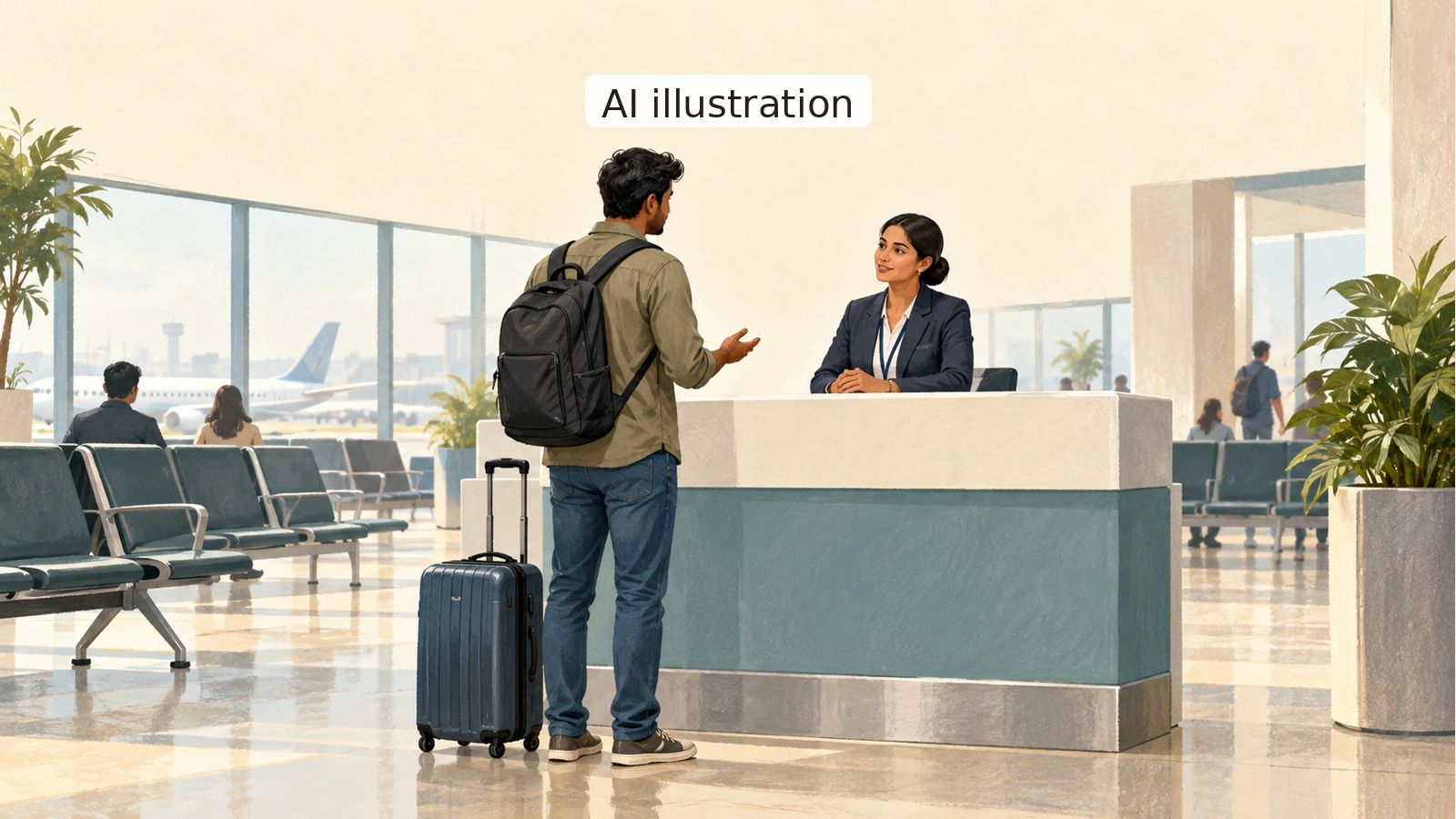
A confirmed ticket does not mean every refusal to carry you has the same remedy. First ask the operating airline to identify the actual reason. An oversold flight, a late arrival at the gate and an unresolved travel-document check are different cases. This guide uses the Indian DGCA rule and Air India's current passenger-rights page, not a worldwide compensation promise.
At the desk: establish what happened
Show the booking, issued boarding pass if available, flight details and required travel documents. Ask: "Am I being refused because there are more passengers than available seats, or for another reason? Please record the reason and tell me the next options." Keep evidence of when you reported for check-in and boarding. These are practical record-keeping suggestions, not proof that a claim has already been accepted.
The DGCA definition requires a confirmed ticket and presentation within the airline's specified boarding time. It excludes reasonable refusals for health, safety, security or inadequate travel documentation. Do not use the oversale compensation figures below for one of those exclusions or a missed deadline without a separate case check. A blank seat field alone does not establish oversale.
Decision tree: which branch applies?
1. No confirmed oversale reason? Ask staff to settle the actual reason first. Do not infer it from a missing seat or a queue.
2. Airline asks for volunteers? Read the offered benefits and conditions before agreeing. This is a choice to surrender the seat, not automatically the involuntary-compensation branch.
3. Refused against your will because passengers exceed seats, despite timely reporting? Compare the alternative flight's scheduled departure with the original scheduled departure using the branches below. Ask the operating airline to apply the rule to your record.
Under paragraph 3.2.1, the airline must first seek volunteers in this seat-shortage situation, subject to the stated practical condition concerning dedicated check-in facilities or gate areas. The offered benefits are at the airline's discretion. Our suggestion is to obtain the complete offer in writing, including the replacement flight and any voucher conditions, before accepting.
Compare departure times, not just the next flight number
The following is paragraph 3.2.2's involuntary seat-shortage branch. The percentage base is the booked one-way basic fare plus airline fuel charge, not necessarily the total ticket price including taxes.
- Alternative scheduled within one hour: the rule says no compensation is payable under this branch.
- Alternative scheduled within 24 hours, after that one-hour exception: 200% of that fare base, capped at Rs 10,000.
- Alternative scheduled more than 24 hours later: 400% of that fare base, capped at Rs 20,000.
- You do not opt for an alternative flight: refund of the full ticket value plus 400% of that fare base, capped at Rs 20,000 for the compensation component.
Ask staff to write the original and proposed scheduled departures, the fare components and the offered remedy. Do not treat the maximum as an automatic flat payment. Paragraph 3.7 allows the specified compensation in cash, bank transfer or travel vouchers with the passenger's signed agreement. Read a voucher proposal rather than assuming it is the only payment form.
Check the onward journey before accepting
Tell staff about onward flights, checked bags and assistance needs. Paragraph 3.2.3 separately addresses a passenger delayed at departure by denied boarding who reaches the final destination at least three hours late; it refers back to paragraph 3.2.2 for compensation by the first-flight airline. Have the carrier check the actual itinerary. This does not establish free replacement of an unrelated separate ticket or automatic payment of a hotel, train or tour loss.
The CAR applies to scheduled and non-scheduled operators and contains a separate foreign-carrier provision. For an international or foreign-carrier case, check the actual route and applicable rules rather than adding several compensation systems together. This guide is not a calculation for every jurisdiction.
Keep one file and use the airline's complaint route
Keep the original booking, refusal reason, timely-reporting evidence, alternative offer, revised ticket, receipts and correspondence privately together. Ask where checked bags will go and which desk you should use next. A complaint does not itself create permission to cross a closed gate or independently leave a controlled area.
For an Air India example, its current rights page directs a grievance first to Customer Support, then the Nodal Officer and Appellate Authority if unresolved, retaining the support case ID. It also lists AirSewa. The DGCA CAR provides airline complaint and AirSewa routes, followed by applicable statutory bodies or courts if still unresolved. These are escalation routes, not a guaranteed payout or a promise of immediate boarding.
Sources and related checks
Checked 29 October 2026: DGCA CAR, Section 3, Series M, Part IV, effective 15 February 2023, especially 2.6, 3.2, 3.6, 3.7 and 3.9; Air India passenger rights and grievance procedure, which currently points to the version effective 15 February 2023. The older booklet inside its linked PDF is not used for refund timelines here.
No seat number: establish the actual document and status. Closed gate: a different next-step problem.

A Miranda House graduate and lawyer who traded courtrooms for slow travel. Cheshta travels with the batches we host ourselves, with a soft spot for travelling alongside elders.
Planning your next trip?
We'll handle insurance, hotels, airport assistance and the itinerary — the same way we do it for every trip.
Questions on this article
asked by readers, answered by us
Was this helpful?
one tap, no sign-up