



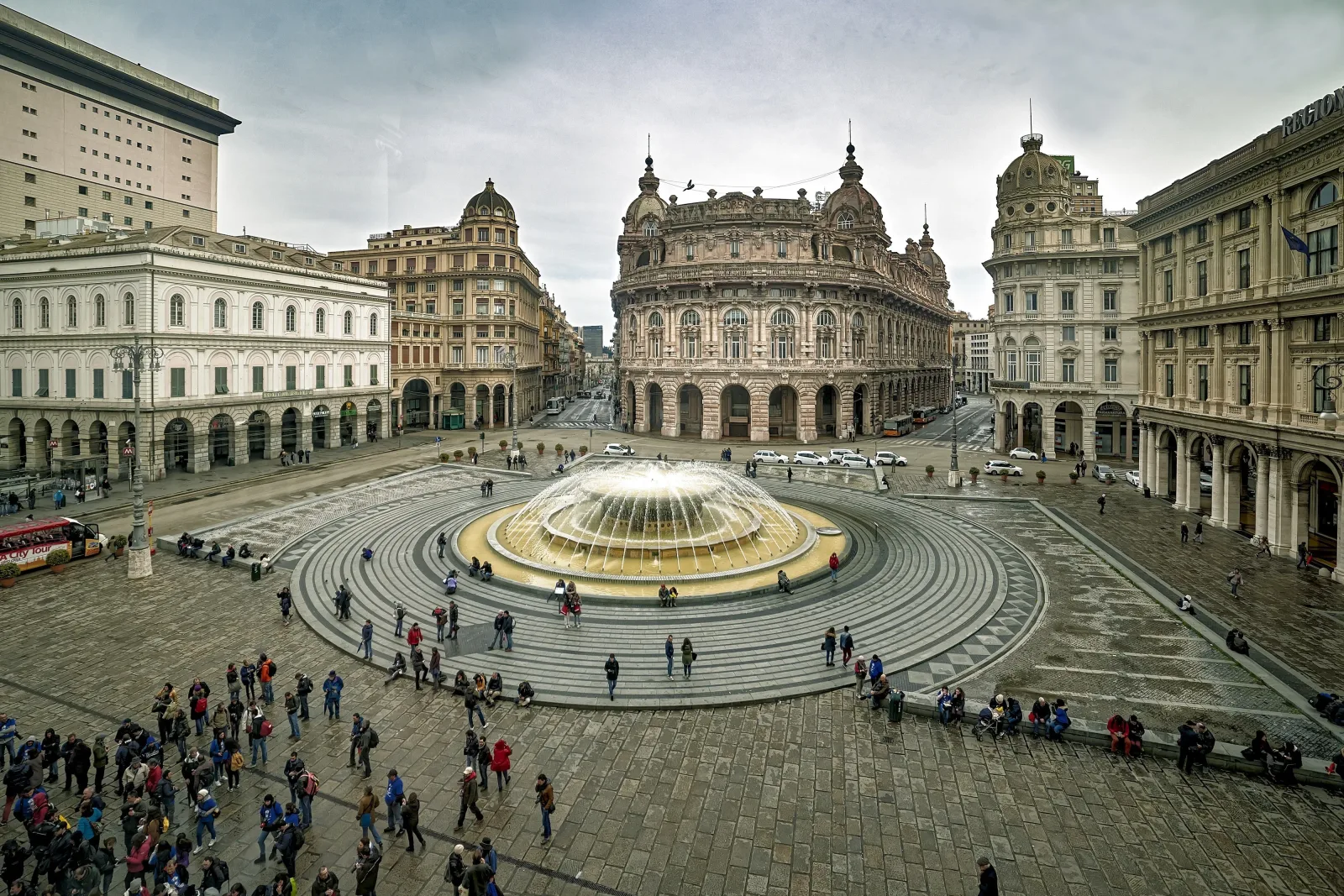

ValeDeNe / Teatroge, Piazza De Ferrari vista da Palazzo Ducale, coi suoi vari palazzi, Genova, Italia. VDN(c), via Wikimedia Commons, CC BY-SA 4.0. Resized and recompressed, no additional crop; this image version is shared under CC BY-SA 4.0. Contextual Genoa photograph, not an identification of the medieval houses or notarial workplaces discussed here, or evidence of current access or conditions. No endorsement implied.
ValeDeNe / Teatroge · Wikimedia Commons · CC BY-SA 4.0

Reviewed 19 November 2026. Historical interpretation using Bezzina's 2023 substantive argument and selected 2022 fiscal-source, residential-acquisition and complete property-management sections. These are one research programme. Leandri's terminology, public-portico, loggia-use and closure passages add specific architectural cases, not a uniform residential model. The complete municipal Ripa history and heritage Banchi report check bounded commercial-property relationships; the latter shares earlier scholarship with Leandri. No original manuscripts, research drawings, buildings or current conditions were inspected.
An association's reach was not the boundary of one estate
In medieval Genoa, an albergo was a historical association of families and allies, not a hotel in the modern sense. Its relationship with houses mattered, but membership, residence and ownership were not identical. Denise Bezzina's research questions an image of the city divided into closed family islands, each containing all its members in one undivided estate. Concentrated holdings existed alongside other residential choices.
The detailed association, property and notarial interpretation here depends on Bezzina's connected 2022 and 2023 studies. They are one research programme, not two independent confirmations. Gaia Leandri's architectural study adds particular loggia histories, while municipal and heritage accounts help distinguish publicly regulated commerce from family premises. Those sources do not independently verify every association's membership or property.
Some families developed more than one residential concentration. Bezzina follows separate de Nigro branches at Banchi and San Lorenzo, and other associations with holdings extending beyond a single neighbourhood. Separate settlement did not necessarily end family connections. Nor does a familiar surname establish that everyone bearing it lived in the same group of houses.
These differences matter to the city's commercial life. Houses and associated ground could support family gathering and third-party transactions, while other porticoes were subject to public-commercial regulation. Our suggestion is to keep the association, the property, the place of dealing and the rules governing its use together, without making their boundaries coincide.
Property could be rearranged without becoming universally common
A 1342 arbitration concerning the de Nigro de Banciis describes the intended removal of two buildings to make a courtyard for the association's men. Seats along its walls and restricted openings towards the street belonged to that proposed arrangement. This was a deliberate relationship between houses and a shared meeting place, not evidence that every family space was an open public square. The written decision is not a surviving complete plan or proof that every instruction was carried out.
The fiscal evidence asks a different question: who was recorded as holding property? In the register Bezzina studies, individual taxpayers predominate over entries for heirs, brothers or other relatives. Those are categories in a selective tax record, not proportions of every Genoese house or inhabitant. Even so, they challenge a general claim that albergo property was necessarily held undivided by the whole association.
One later annotation makes change more specific. A house with a tower listed in 1414 for the heirs of Taddeo Cattaneo della Volta passed to Demetrio alone in 1423. Other cases concern shares or properties moving between relatives. A holding could remain within family relationships while its recorded ownership arrangement changed. Individual holding did not mean the absence of cooperation, just as inheritance in common did not prove permanent collective ownership.
The register also leaves gaps. Associated families are missing from its picture, some other fiscal records have been lost, and exemptions could affect what was entered. A taxpayer's registration area need not be the precise location of every property. These limits prevent turning the recorded holdings into a complete map of the associations whose premises also hosted meetings and dealings.
Notarial work brought wider dealings to residential premises
A notary gave written form to transactions and other legal acts. Bezzina's examples place that work inside or in front of elite houses, shops, stores and porticoes. The workplace could connect a residence with commercial business without making the entire property a public institution. It also need not have been a loggia merely because dealings occurred there.
At Banchi, the city's commercial heart, Giuliano Canella drew up deeds between 1408 and 1415 at a working bench beneath Carlo Lomellini's dwelling. This is a specific relationship between domestic property and professional transactions. It is not a reconstructed interior or a claim that every nearby house performed the same role.
The de Nigro example is more closely tied to legal expertise within a family network. In the 1340s, Leonardo Osbergerio worked before de Nigro houses near San Lorenzo and Vico del Filo. His records include arbitrations involving the legal specialist Celesterio de Nigro and a circle of allied families. Residential premises were therefore also places where economic and inheritance disputes could be handled.
The recorded workplaces and dealings are firmer evidence than a complete hierarchy of clients dependent on each association. Bezzina presents wider clientage as a less secure interpretation and leaves questions about alliances and space unresolved. Contact across social groups does not by itself establish equality, harmony or a single system of control. It does show why these houses belong in an account of the city's exchanges, rather than only its domestic architecture.
A family loggia could admit outsiders without becoming a public street
Leandri describes the loggia as a place for family gathering as well as particular business uses. The word does not always identify the same physical arrangement in historical documents. Nor should an arched opening alone decide whether a space was a family meeting place, commercial premises or a public passage. Form, use and regulation need separate evidence.
A request from Corrado de Campis in 1472 makes the meeting function specific: he sought a loggia for gatherings connected with funerals, weddings and meals. The municipal permission included conditions protecting public space, and the account refers to use by neighbouring families. A particular proposed gathering place could therefore involve both household interests and public regulation. This is not a universal rule for every Genoese loggia or proof of completed construction.
Later testimony gives another kind of evidence. In the 1619-1620 dispute over Nicolò Grimaldi's loggia, witnesses recalled benches, sellers and artisans, permission sought from the proprietor and the exclusion of unwanted users. These recollections concern earlier practice but were recorded much later than the medieval cases. An outwardly open space could have visitors and working occupants without everyone possessing the same claim to use it.
Leandri's particular cases are useful, but her broader account sometimes presents association members as sharing one neighbourhood more uniformly than Bezzina's evidence supports. That difference should remain visible. Use the architectural and documentary cases without assuming that every association had the same residential layout, common ownership or rules for outsiders. The notarial meeting place and the publicly regulated portico must still be tested separately.
Ripa and Banchi connected commerce with different kinds of control
The municipal museum's Ripa account describes a covered commercial frontage developed under consular direction. Owners of buildings beside it could extend their dwellings above the portico but were not to obstruct the commercial space below. Housing and trade were connected vertically, yet the public-commercial rules were not simply those of a family loggia. This independent institutional account checks that distinction; it does not prove that an albergo planned the waterfront.
Banchi contained a different combination. Leandri distinguishes a small municipal loggia from privately held porticoes used for financial and commercial activity. Municipal intervention concerned keeping space available amid benches, goods and people. A private building's participation in the commercial setting did not necessarily make the commune its owner.
The heritage report adds a particular early-fifteenth-century agreement involving Di Negro house ground and commercial premises below. Later arrangements changed again: Leandri describes an obligation affecting part of the Imperiale portico, seating and disagreements about movement and the visibility of shops. These were different properties and moments, not one unchanged loggia passing through a single chain of ownership.
The later Loggia dei Mercanti belonged to a wider remaking of Banchi rather than the simple survival of all those earlier porticoes. Exact dimensions and one final completion date are not needed to see the relationship. Family property, professional dealings and municipal commercial requirements could meet in the same area while remaining different kinds of claim.
Closing a loggia changed an interface, not only a facade
Leandri relates the gradual closure of some loggias to changing houses and uses. A former portico might become part of an entrance hall, while other enclosed spaces were divided for work or selling. Such changes affected the relationship between the street, domestic premises and places where people gathered or did business. They were not merely a new decorative treatment applied to an otherwise fixed arrangement.
The Grimaldi dispute makes that relationship contested. Opponents appealed to remembered open use; other witnesses described signs of family control and permission. Leandri records eventual permission to close the space. The case shows why apparent openness and a public right cannot be treated as synonyms. Its historical outcome supplies no rule about present property or access.
Keep this later evidence beside the earlier property and notarial cases without flattening their dates. A courtyard rearrangement, a transfer from heirs to one holder, a notary's working bench and a regulated commercial portico answer different parts of the same urban question. None proves that all Genoa followed one house type or that association premises were either wholly private islands or freely available public space.
Genoa becomes clearer when those relationships stay connected: associations with varied residential reach, properties managed and transferred in different ways, houses serving as places of notarial exchange, and commerce regulated through nonidentical spaces. This is an interpretation of bounded published research, not a new examination of original records or buildings. It establishes no present operations, ownership, access, physical condition, safety or social benefit.
Sources
- Bezzina 2023, substantive association/notarial argument, not original manuscripts; checked 19 Nov 2026
- Bezzina 2022, selected fiscal/residential sections and complete management cases; same programme; checked 19 Nov 2026
- Leandri 2023, bounded terminology, public-portico, use and closure sections only; checked 19 Nov 2026
- Municipal museum Ripa history, complete historical text, not current rights; checked 19 Nov 2026
- Gazzano 2015 Banchi heritage report, historical property relationship; shared scholarship, conflicting dimensions/dates omitted; checked 19 Nov 2026
Questions people ask at the gate
Does albergo mean a hotel in this account?
No. It means a historical association of families and allies. Membership, residence and ownership could have different limits. Some holdings were concentrated, but the evidence does not support one universal closed estate containing every member.
Did every association hold its property undivided?
That is not supported. Bezzina's selective fiscal evidence distinguishes individual taxpayers from heirs, brothers and other relatives. Particular annotations also show arrangements changing, including a house passing from heirs to Demetrio Cattaneo della Volta alone. Those records are not a census of all Genoese property.
What do the notarial workplaces add?
They connect residential and other elite premises with transactions, arbitration and wider dealings. Canella's workplace beneath a Lomellini dwelling and Osbergerio's work near de Nigro houses are specific examples. They do not establish that every notary worked in a loggia or that every customer belonged to a fixed clientage network.
Was every open loggia a public passage?
No such conclusion follows from its appearance. Leandri distinguishes family premises, permitted outside use and publicly regulated porticoes. The later Grimaldi testimony also records disagreement about what open use meant. These are historical cases, not current access or property-law advice.
Were the Ripa and Banchi the same kind of commercial space?
No. The Ripa account describes publicly regulated commercial ground beneath building extensions. Banchi combined differently held porticoes and changing arrangements, followed by a different mercantile building project. Shared commercial activity did not give every space the same owner, rules or history.
How independent and complete is this interpretation?
Its detailed association, property and notarial argument depends on Bezzina's 2022 and 2023 studies as one programme. Leandri's particular architectural cases add evidence, but her more uniform residential model remains in tension with it. Municipal and heritage accounts check public-commercial relationships without confirming every family history. Selective fiscal records, later testimony and unresolved clientage questions prevent a complete map of households or control.
Next walk starts at a new gate.
Was this helpful?
one tap, no sign-up

A Miranda House graduate and lawyer who traded courtrooms for slow travel. Cheshta travels with the batches we host ourselves, with a soft spot for travelling alongside elders.