




Reviewed 18 November 2026. A memorial-architecture guide using Rajasthan Tourism and national tourism descriptions. Check current official visitor information.
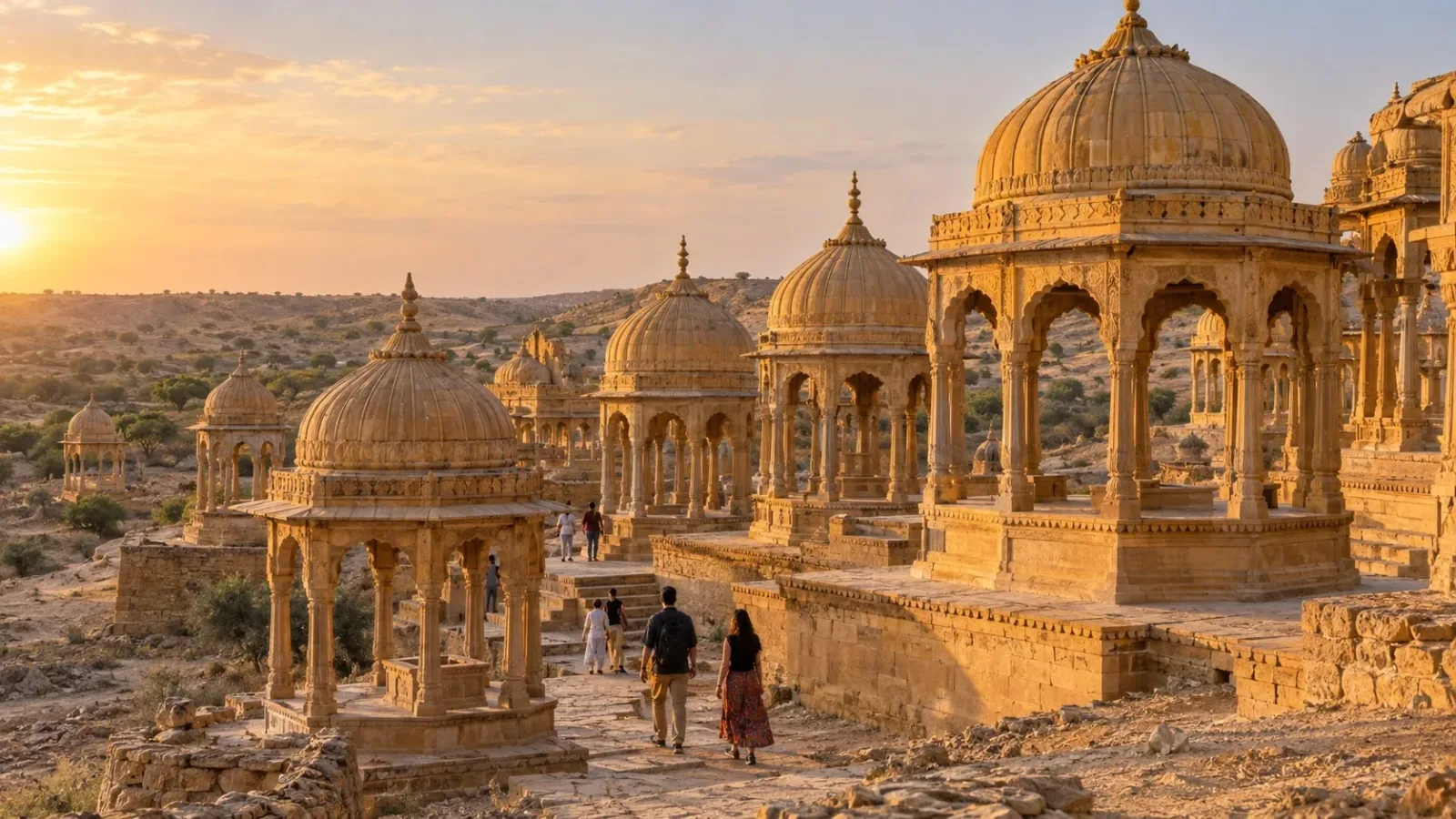
AI illustration: a fictional sandstone memorial scene inspired by Bada Bagh. Not an actual location, person, route inspection or service.
Begin with the royal memorials
Rajasthan Tourism calls Bada Bagh, also Barabagh, a garden complex containing royal chhatris or cenotaphs of Jaisalmer rulers. Begin with that commemorative purpose rather than treating the buildings only as a photograph background.
Our suggestion is an architecture-led outing: give a few memorials attention instead of collecting every sunset location. Check current official visitor information and keep a meal, a break and the return.
Do not turn a pavilion into a burial record
The official descriptions identify royal memorials. That is enough to explain the main interest, but not enough to establish the physical contents beneath every individual structure.
This guide supplies no burial inventory, complete cremation history or ruler-by-ruler identification. A photograph of a dome does not identify whose remains are present. Treat the memorials respectfully and follow current official instructions.
Compare sandstone details
Incredible India describes sandstone chhatris with carving and latticework. Use those descriptions as prompts for looking, not a promise that every pavilion repeats the same features.
Compare how a support meets a canopy, how a pattern fills an edge and how one pavilion relates to the group. These are suggested observation questions, not an architectural classification of every monument.
Let the garden name be context
Rajasthan Tourism translates Barabagh as Big Garden and describes a garden complex. A place name can carry history without describing every feature of the present visitor experience.
Keep the architecture as the subject. Do not turn descriptive tourism language into an inventory of current facilities. Check current official visitor information for your visit rather than reading a historic name as an inspection.
Keep Vyas Chhatri descriptions separate
The state page describes royal cenotaphs under Bada Bagh and a Brahmin cemetery under Vyas Chhatri. Its Vyas entry also uses Bada Bagh in the location wording, so this guide does not turn those entries into a confident two-stop map.
Keep each commemorative subject attached to its own description. If a plan uses only the word chhatris or sunset point, clarify the exact named place rather than assuming that the labels settle the location.
Choose the memorials before the light
Rajasthan Tourism highlights sunset views, while national tourism discusses light on the sandstone. Those descriptions explain a visual interest, not a forecast or a guaranteed photograph.
Finish with the detail that interested the group. Another Jaisalmer stop is optional, not a requirement for understanding the memorials. Check current official visitor information and keep food, rest and the return.
Sources
Questions people ask at the gate
What is the main suggested interest?
Bada Bagh as royal memorial architecture, with a few sandstone chhatris given careful attention.
What other name does Rajasthan Tourism use?
Barabagh, translated as Big Garden.
Does a chhatri photograph establish a burial?
No. This guide does not establish the physical contents beneath any individual monument.
What details does national tourism describe?
Sandstone carving and latticework among the chhatris. Look at the actual monument rather than expecting identical features everywhere.
Does this guide map Bada Bagh and Vyas Chhatri as two stops?
No. The state page uses overlapping location wording while giving different commemorative descriptions. Clarify the exact named place.
Is a sunset photograph necessary?
No. The memorial architecture is the main suggested interest. Check current official visitor information and keep food, rest and the return.
Next walk starts at a new gate.
Was this helpful?
one tap, no sign-up

A Miranda House graduate and lawyer who traded courtrooms for slow travel. Cheshta travels with the batches we host ourselves, with a soft spot for travelling alongside elders.