




Historical interpretation checked 19 November 2026. The central plot-development finding comes from the full introduction, pp17-20, of Guzzardi and Luminati's 2022 book; the available first-chapter opening ends on p22. Later detailed allocation and building chapters were not read. Piazza's complete six-page paper, Nixon's complete supplied introduction, two local-institute histories and the older History Today article supply differently scoped context, with shared research lineages. Historical plans, deeds, excavation records, research images and present sites were not independently inspected. This is not practical access, ownership, safety or current-condition advice.
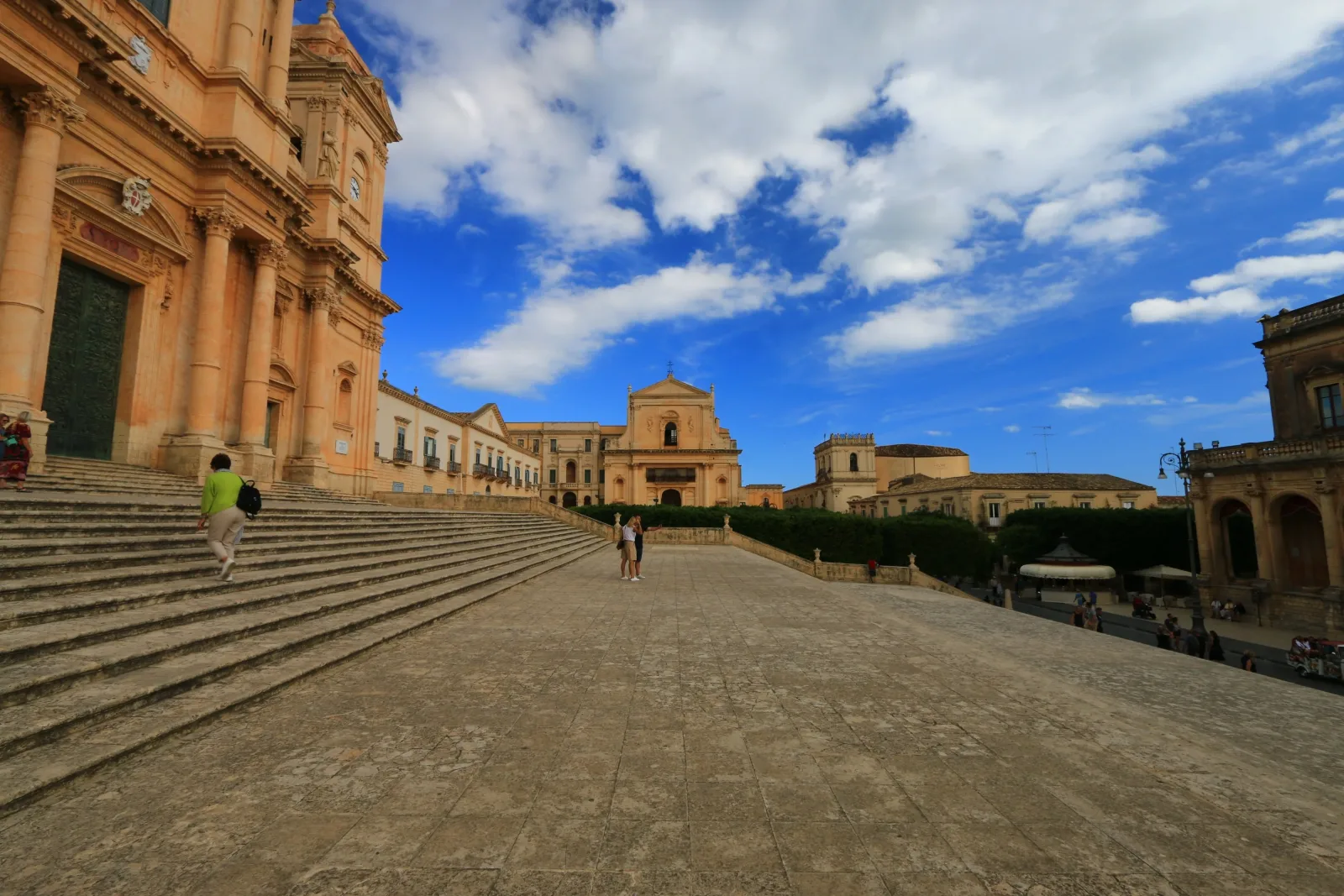
Piazza Trigona, Noto, a contextual view of the later town, not the abandoned old town or evidence identifying the relocation ground or plots. Photograph: Benjamin Smith / Wikimedia Commons, "Noto - Piazza Trigona - 2.jpg", CC BY-SA 4.0. Resized and recompressed; no additional crop. This image version is available under CC BY-SA 4.0.

The new Noto was not the old town rebuilt in place
Noto's reconstruction after the 1693 earthquake involved a change of site. The earlier settlement stood on Monte Alveria; the new town developed on the ground known as the Meti. That distinction changes the historical question. Rebuilding meant deciding where the town should stand, as well as finding ways to occupy and build on the receiving ground. It was not simply a matter of replacing fallen buildings along all the old streets.
Lorenzo Guzzardi and Michele Luminati begin their 2022 study with the difficult choice of the new site. Their opening chapter describes disagreement among survivors, alternative locations and the role of technical advice. The Meti ground was not even among the locations proposed at the first February assembly they discuss. A later majority decision therefore needs a history; it cannot be treated as an obvious answer already shared by everyone after the disaster.
The result was the eighteenth-century new town, but the result should not be read backwards as the only possible beginning. The authors distinguish the decision to leave Alveria from explanations of why the Meti site prevailed. Their opening discussion challenges a simple story in which the authorities imposed relocation against the inhabitants' wishes. It also starts to qualify the idea that choosing supposedly neutral ground avoided conflicts among local nobles.
Those qualifications do not give us a complete account of each participant's motives. The available opening ends before the latter argument is finished. What it does establish is a problem with reducing the move to one designer, one order or a unanimous choice. Noto's later form belongs to a relocation whose decisions and implementation need to be kept separate.
A decision about the site was not a single start to construction
The local institute's short history describes a long dispute between rebuilding at the old location and other choices. Its account identifies the 1702 direction as continuing reconstruction already undertaken on the Meti hill. That wording matters. A later authoritative decision did not necessarily create a previously unoccupied town site or mark the first act of building there.
Guzzardi and Luminati's introduction explains why the early interval deserves attention in its own right. Their research systematically examined surviving Noto notarial records for 1693-1702 and combined archival work with archaeological investigations made during restoration. The records concern daily transactions and building activity as well as institutions. Their method moves the account beyond official decisions and the names of celebrated architects.
An older 1983 account in History Today stresses the long delay and the misery of temporary housing before the final direction to build. It should not be compressed into a decade during which nothing was constructed. The newer study instead follows occupation, provisional buildings, building work, demolition and alteration. Waiting for a settled political answer and making places to live were not necessarily successive, neatly separated stages.
This distinction is about chronology, not an argument that disagreement was harmless or that temporary accommodation was adequate. Nor does the start of construction prove that the move had become consensual. A decision, an occupied site and a finished building are different kinds of evidence. Combining them into one founding moment hides the process the newer research sets out to recover.
The receiving ground had a history before the relocated town
Moving to a new town site did not mean beginning on ground without a past. Guzzardi and Luminati explain that archaeological work expanded their investigation to features predating the reconstruction. Their study connects that earlier site history with the later settlement, rather than treating the Meti ground merely as a blank surface on which a new design was drawn.
Their collaboration joined two kinds of evidence. Notarial documents could record activities and transactions; excavation could locate successive physical remains. The authors describe learning to read those forms of evidence together. This does not mean that every written record identifies a visible structure, or that every excavated feature has a complete ownership history. The point is the relationship between documentary time and occupied ground.
The scope here is deliberately limited. This account uses the authors' complete introduction and the available opening of their first chapter, not the later detailed allocation and building studies. It presents their general findings. It does not reconstruct an individual allotment, explain its legal mechanism, establish an owner chain, settle the Astuto dispute or supply a detailed building case. Original deeds, excavation records and historical plans have not been examined for this account.
Within that limit, earlier occupation still changes how the relocation is understood. The new settlement was made at another site, but that site's earlier features and physical constraints formed part of the conditions of construction. Calling it new describes its relationship to the town left behind; it does not establish that all its ground was historically empty or freely available.
A plot could change from provisional shelter to larger masonry buildings
The authors' introduction gives a general process more specific than an instant replacement of ruins by a monumental town. Within an initially assigned plot, a small provisional structure could be replaced over decades by increasingly substantial masonry buildings. Construction could occupy the whole original plot or incorporate adjoining plots. The ground, the building and the extent of the eventual building complex therefore need not describe the same moment.
They also describe successive building phases sharing space with continuing construction activity inside the plot. A completed-looking street front does not by itself reveal that sequence. Nor can the eventual size of a building tell us the dimensions of the first occupation. The introduction supports the presence of growth and alteration; it does not supply a standard plan repeated by every household or institution.
The authors connect these phases with several kinds of constraint: the site's physical conditions and earlier features, further earthquakes, legal and administrative limits, available money, social strategies and cultural models. None should be substituted as the single explanation for all construction. Their account asks how such conditions worked together, instead of presenting the later town as a design carried out without interruption.
This is the introduction's general finding, not a newly reconstructed parcel history. It cannot tell us which neighbour transferred which piece of land, how a particular transaction was authorised or when every boundary changed. Its value lies in distinguishing a town built through successive occupations and works from a town imagined as complete at the moment its street arrangement was chosen.
The monumental centre was part of a larger settlement
Architectural historian Stefano Piazza places Noto's celebrated monumental area within a wider and more varied eighteenth-century town. In his interpretation, the best-known quarter expresses the strength of noble and ecclesiastical groups, rather than standing for the complete settlement. The cathedral-centred architectural composition was one part of the town that developed after relocation.
That is an interpretation of social and spatial power, not a complete map identifying every resident by wealth or rank. Piazza's discussion draws on earlier research, including work by Dufour and Luminati. It should not be counted as an independent confirmation of each plot sequence described in the later book. Its useful contribution is the warning against making the monumental quarter the whole town.
Valentina Balsamo's local historical synthesis offers another way to distinguish stages. She relates the 1699 Formenti plan, a later depiction associated with Paolo Labisi and the 1714 and 1748 Riveli, records of people and property, to changing building categories. Her account includes provisional structures, more substantial houses, shops and larger buildings. These are her readings of the documents; the originals have not been independently checked here.
Her treatment also shows why an image is not automatically a record of completed work. She suggests that an extra storey shown on the Casa Senatoria may represent intended enlargement rather than construction already carried out. That tentative interpretation must remain tentative. A depiction, a property record and surviving fabric answer related questions, but they are not interchangeable proofs of the same completed town.
A coherent appearance does not prove one uninterrupted project
The connection between the old and new Noto is consequently larger than a contrast between ruins and elaborate facades. It includes the decision to leave one settlement, the disputed choice of another site, the receiving ground's earlier history and the changing extent of construction within plots. The later monumental appearance is a result to explain through those relationships, rather than evidence that they were simple.
Martin Nixon's introduction to his study of eighteenth-century Sicilian architecture likewise questions the idea of a single regional rebuilding programme. He distinguishes separate local reconstructions, ambitions and competition. That wider argument helps resist an all-purpose explanation for Noto, but it is not the detailed Noto chapter, nor separate proof of the general plot sequence in Guzzardi and Luminati.
The evidence used here has different scales. The authors' introduction supplies the general property-development process; Piazza interprets the monumental quarter within the wider town; Balsamo mediates plans and property records; Nixon frames the regional problem. These sources share parts of an older research literature. Their agreement on complexity should not be mistaken for several independent surveys confirming every building.
The defensible historical picture is of a relocated settlement made through decisions, occupation and successive construction, not a finished town transferred whole from a plan to empty land. The general-process ceiling remains important: no individual allocation or detailed building history is established here. Neither the town's historical appearance nor this account determines present ownership, access, condition, safety or the experience of every inhabitant.
Sources
- Guzzardi/Luminati 2022, publisher record; introduction-level general process; checked 19 Nov 2026
- Guzzardi/Luminati actual preview, full introduction pp17-20 and opening pp21-22 only; checked 19 Nov 2026
- Piazza 2012 pp23-28, monumental quarter within wider town, shared research lineage; checked 19 Nov 2026
- Nixon 2023 supplied introduction pp15-27, regional context not Chapter3; checked 19 Nov 2026
- ISVNA brief history, disputed site and 1702 direction to continue building; checked 19 Nov 2026
- Balsamo/ISVNA, mediated plans and Riveli; tentative extra storey interpretation; checked 19 Nov 2026
- Adler, History Today 1983, dated contrasting chronology, not current conditions; checked 19 Nov 2026
Questions people ask at the gate
Was the present historic town rebuilt on the same site as Noto Antica?
No. The old settlement stood on Monte Alveria, while the new town developed on the Meti ground after the 1693 disaster. The historical question includes the decision to leave the earlier site and the occupation and construction of the new one. This does not supply a route or a current visitor-access claim.
Did everyone agree on the Meti site immediately?
No. The 2022 study's opening describes alternative sites, disagreement and technical advice. The local institute also records prolonged disputes. A later decision and continuing building do not prove unanimous consent. The available opening does not provide a complete account of every participant's motives.
Was nothing built until the 1702 direction?
That would flatten the evidence. The local institute describes the direction as continuing rebuilding already undertaken. Guzzardi and Luminati study the surviving 1693-1702 notarial record and describe successive occupation and construction. Temporary shelter, political decisions and permanent building should not be turned into one instantaneous start.
Was the new site empty before reconstruction?
The authors' archaeological and archival research identifies earlier features at the receiving site. New refers to the relocated town, not proof that its ground had no history. This account does not independently identify or date individual excavated remains, map their boundaries or establish the ownership of that ground.
Does this account establish how an individual plot was allocated or acquired?
No. Its property evidence is explicitly limited to the authors' introduction-level general process: provisional occupation, more substantial masonry buildings and growth within or sometimes across adjoining plots. Detailed allocation chapters, legal mechanisms, owner chains, the Astuto outcome and individual building cases are outside the evidence used here. Original deeds and plans were not examined.
Can the monumental centre stand for the whole new town?
Not without qualification. Piazza places the celebrated quarter within a wider differentiated settlement. Balsamo's mediated account distinguishes building categories and phases. Neither gives this account a complete social map. A coherent architectural appearance also does not prove one construction phase, universal agreement or identical benefits for all residents.
Next walk starts at a new gate.
Was this helpful?
one tap, no sign-up

A Miranda House graduate and lawyer who traded courtrooms for slow travel. Cheshta travels with the batches we host ourselves, with a soft spot for travelling alongside elders.