




Read Siena through collection, storage, different water uses and repeated maintenance. Historical descriptions do not establish present drinking water or underground access.
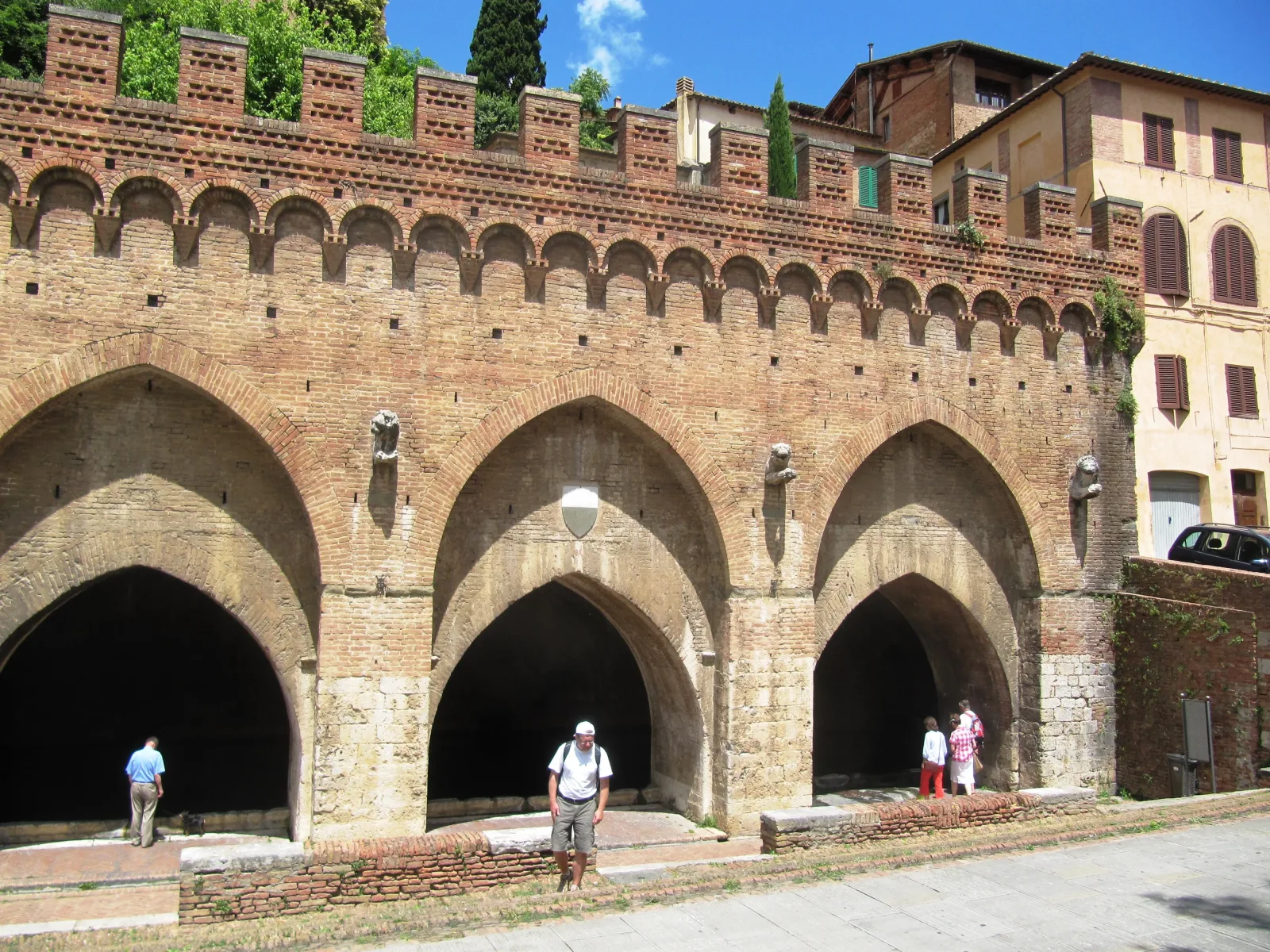
Fontebranda, Siena, a contextual fountain view, not evidence of current water use or underground conditions. Photograph: Palickap / Wikimedia Commons, CC BY-SA 4.0. Recompressed; no resizing or additional crop. This image version is available under CC BY-SA 4.0. Wikimedia Commons.

A hill city needed more than a source of water
Siena's water history joins the needs of a hill city with the work of bringing water to places where people lived and worked. Households, animals, cloth production and institutions needed supplies, but not all for the same purpose. The historical question is therefore larger than how an underground passage reached a fountain. It includes where water went next, what could be done with it and who had to look after it.
Costantini and Martini's study of Siena's landscape describes the pressure that urban growth placed on limited local springs. Underground works enlarged that supply and brought water towards different parts of the settlement. The city's position mattered, but geology alone did not determine the result. Excavation, distribution, storage and choices among uses connected the ground beneath Siena with its working life above.
The public fountain was a meeting point between those processes. It could be an architectural presence and a place for obtaining water, while nearby basins and channels served less ceremonial work. Fonte Gaia in the Campo and Fontebranda below the hill did not occupy interchangeable positions in the city. Their relation to surrounding activities matters alongside their visible form.
Nor should the large public supply be made to stand for every provision. Santa Maria della Scala's history includes rainwater cisterns, a well and later pumping arrangements. Those features prevent a simple story in which one completed underground system supplied all needs in the same way. The city combined different sources, structures and practices, and changed them over time.
Underground collection was different from storage
The passages called bottini intercepted water moving through the ground and conveyed it towards the city. The university-hosted Water Museum account describes permeable ground above less permeable layers, with water collected along that relationship. Rain belonged to this hydrology, but the bottini were not simply open surface channels carrying a storm directly into a household tank.
Inside a passage, a smaller channel called the gorello carried the flow. The space through which workers could move and the channel carrying water were related but distinct parts of the construction. Accounts also describe brickwork where required. An explanation of the bottini therefore needs to distinguish the excavated passage, its water channel and the work needed to keep the route usable.
The landscape study distinguishes the principal Fontebranda and Fonte Gaia supplies and describes settling arrangements before distribution. It also discusses later branches taking water towards wells beneath palaces and religious buildings. Collection, settling and delivery were different tasks. A later connection to a private building should not be projected backwards as the original condition of every medieval household.
Storage had another role. A cistern could hold rainwater gathered within a building complex; a well could reach water below it. Calling all these structures underground does not make them the same technology. Siena's history is clearer when the function and period of a feature remain attached to it, rather than treating every shaft or chamber as another piece of one uniform supply.
A fountain complex distributed water among different uses
At Fontebranda, the heritage account distinguishes water for people, overflow for animals and a further basin for laundry. Water then served working activities downstream. The arrangement gave successive uses different positions in relation to the incoming supply. The important point is the connection between basins and work, rather than the fountain understood only as a decorated place from which water emerged.
The broader landscape study places such arrangements within a varied urban economy. Water could serve washing, mills and cultivation as well as household needs. This was not merely repeated consumption of an unchanged resource. Each use could affect what came after it, making the position of a basin, workshop or channel important to other people depending on the flow.
Yet one neat arrow from drinking to animals to laundry to industry would be too simple. Costantini and Martini also describe a separate allocation of cleaner incoming water to pools or cisterns used in wool and cloth work at Fontebranda. Production did not invariably receive only the final dirty overflow. Different tasks required different arrangements, even within the same working area.
The fountain complex consequently joined provision with the organisation of activities around it. Cloth working, animal use and domestic washing were connected to water, but were not interchangeable claims upon it. The surviving descriptions support that differentiated history. They do not establish a complete route through every basin at every date, or a single arrangement repeated at every Sienese fountain.
The statute excerpts prescribe conduct, not proof that it happened
The legal evidence used here has a firm limit. It consists of original-language excerpts reproduced in Michael Kucher's published notes, with their edition and page references, not the article's missing main text or a complete reading of the statute edition. These excerpts show what particular rules prescribed. They do not prove compliance, successful enforcement, continuous operation or a health outcome.
In the 1309-1310 Costituto, edited by Alessandro Lisini in 1903, distinction III, rubric 107, volume II, page 53, the quoted provision prohibits wool washing and placing hides in specified Fontebranda laundry and animal-basin spaces. Rubric 108, page 54, prohibits throwing lime, hair and related material into a named basin. These were particular restrictions on activities and locations, not a general ban on all production around fountains. [S10, notes 83, 93-94, 103]
Rubric 109, also on page 54, restricts specified hide treatment in and near the named Fontebranda premises. A different provision, rubric 135, page 63, permits dyers to make a covered conduit through public streets for their water. Restriction and accommodation appear together in these excerpts. They show attempts to organise working uses, rather than evidence that the authorities simply removed every workshop from the water supply. [S10, notes 84, 95]
Maintenance also appears as a public responsibility. Rubric 126, pages 60-61, provides for guarding, cleaning and repair at communal expense following a neighbourhood request. That is evidence of a prescribed way to seek work, not a register of completed repairs. Kucher also reports difficulty locating period criminal proceedings. Missing case records cannot turn a rule into proof that everybody obeyed it. [S10, notes 38, 114]
The hospital combined a well, cisterns and later water lifting
Santa Maria della Scala brings another scale into the city's supply history. La Diana's account identifies rainwater storage associated with internal courts, alongside the Pozzo del Rotone, a well reaching groundwater. A building complex could therefore depend on more than one form of provision. Its cisterns should not all be described as outlets of the public bottini merely because they lay below occupied rooms.
The same account describes alteration rather than an unchanging medieval installation. The Chigi cistern already existed before it was enlarged and reworked. Other spaces lost their open-court form through later building changes. The history of water storage was joined to the changing hospital building, not confined to the first construction of a single permanent arrangement.
Water and washing also had their own places within the institution. La Diana relates a cistern's later name to the movement of dirty linen and describes the washing place associated with the wet nurses' house. These examples connect water with the hospital's daily work. They are not evidence that every surviving chamber had one use throughout its life or that the institution's hygiene can be judged from the structures alone.
Much later, steam-powered lifting brought water from Fontebranda up to the hospital rooms described as the Sale delle Cannelle. That provision belongs to a later phase, not to the medieval gravity-fed works. The account's list and narrative disagree on the precise year, so no exact year is adopted here. The supported distinction is between earlier well and cistern provision and later pumping.
A long-lived supply still depended on repeated work
Museo Galileo describes the bottini as a system made progressively through the Middle Ages and Renaissance, requiring continued maintenance. That emphasis changes the meaning of an engineering achievement. Excavation did not end the need for labour, attention or further attempts to obtain water. The channels were an ongoing responsibility rather than a once-finished solution to every urban demand.
The Water Museum chronology likewise records interrupted works, renewed projects and later repairs. It is a secondary historical account, not a set of construction records independently examined here. Its useful contribution is the sequence of repeated attempts and adjustments. No single completion date is needed to recognise that Siena's supply was made and remade over a long period.
Later modern supply from the Vivo springs changed the place of the older arrangements in the city. That transition does not erase the earlier variety of public fountains, private connections, cisterns and wells. Equally, a historical account of their roles cannot establish how every old branch operates now, whether water is drinkable or which underground spaces can presently be entered.
Siena's water history is thus a relationship among sources, conveyance, storage, differentiated work and continuing care. The statute excerpts add specific prescribed boundaries to that relationship, not proof of its perfect operation. Holding those distinctions together explains more than either a celebration of tunnels alone or a claim that ordered reuse had solved scarcity for the whole city.
Sources
- Costantini and Martini 2010, water section pp290-292 checked; no original figures; checked 19 Nov 2026
- Pulselli et al 2010, full paper checked; historical introduction only, no model verdict; checked 19 Nov 2026
- Siena Water Museum, historical bottini account; checked 19 Nov 2026
- Museo Galileo, historical construction and maintenance; checked 19 Nov 2026
- La Diana, varied water places and provisions; checked 19 Nov 2026
- La Diana, Santa Maria della Scala water history; conflicting pumping year excluded; checked 19 Nov 2026
- Santa Caterina heritage, Fontebranda historical use sequence; checked 19 Nov 2026
- Water Museum mirror, university hosted, not independent faculty research; checked 19 Nov 2026
- Water Museum chronology, repeated work and changes; checked 19 Nov 2026
- Kucher 2005, abstract and all notes checked; quoted statute excerpts only, main body absent; checked 19 Nov 2026
Questions people ask at the gate
Were the bottini simply rainwater cisterns?
No. The bottini intercepted and conveyed water through underground passages. A cistern stored water, including rainfall collected within a building complex. Siena used both, but their shared underground setting does not make collection, conveyance and storage the same process. Santa Maria della Scala also had a groundwater well.
Did all working uses receive only dirty overflow?
No. Descriptions of successive fountain basins explain an important pattern of reuse, but the landscape study also describes cleaner water diverted to wool and cloth work at Fontebranda. Different production tasks could have different provisions. One uninterrupted downstream chain would oversimplify the evidence.
What do the Fontebranda rules actually establish?
The excerpts prescribe restrictions on wool, hides, lime and related activities in named spaces. They also include permission for dyers' covered conduits. Their wording supports a site-specific account of intended conduct and accommodation, not a claim that all workshops were banned or that every rule was followed.
Was the hospital supplied in the same way throughout its history?
No. La Diana describes rainwater cisterns, the Rotone well, alterations to storage and later steam-powered lifting from Fontebranda. These belong to different provisions and phases. They do not form evidence for one simultaneous medieval arrangement throughout the institution.
Does this history establish present drinking water or tunnel access?
No. Historical drinking use, a museum description and a modern reuse proposal are not a current water-quality test or access confirmation. This account does not provide tunnel-entry advice, opening information, safety assurances or permission to drink from a fountain.
How much of the legal history has been checked?
This account uses the original-language statutory excerpts reproduced in Kucher's published notes, including the Lisini edition, rubric and page references. The main article and full statute edition were not recovered. The ceiling is prescriptive: what those excerpts say, never proof of compliance, enforcement, continuous operation or public-health success.
Next walk starts at a new gate.
Was this helpful?
one tap, no sign-up

A Miranda House graduate and lawyer who traded courtrooms for slow travel. Cheshta travels with the batches we host ourselves, with a soft spot for travelling alongside elders.